



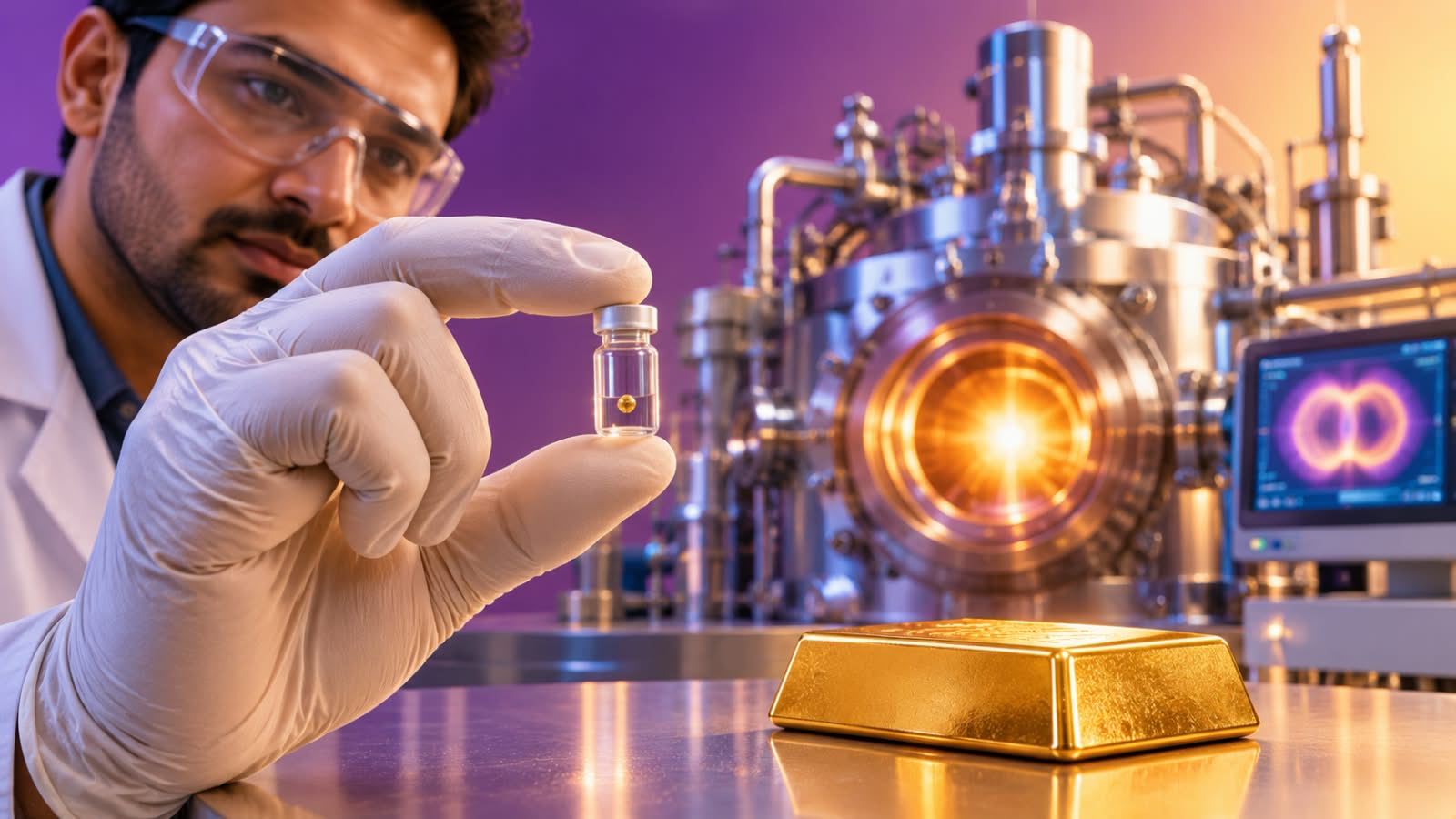
A San Francisco startup says it has turned mercury into stable gold, and the first question people asked was whether prices will collapse as diamonds did. If you invest in gold online or keep jewellery in a locker, that worry makes sense. The short answer is no, not anytime soon.
Lab made gold is real science, but the quantities are tiny, and the costs have not been published. The gold would also need years of storage before sale, according to the company's own paper. Before anyone sells in a hurry, the numbers deserve a closer look.
What Marathon Fusion Actually Announced
On 21 October, Marathon Fusion, a US-based startup, said it had achieved a mercury to gold conversion in September at ten times the rate of CERN's 2025 record. The claim is unverified, and the company has not said how much gold it made or what it cost.
The process is simple to describe. Fast neutrons from fusion strike mercury-198 and create mercury-197, which decays into gold-197 with a half-life of about 64 hours. That is the only stable form of gold, so the chemistry is sound.
For perspective, CERN's ALICE experiment made roughly 29 trillionths of a gram of gold over four years. Ten times faster is still far too small to see.
You May Also Like: Why Do Gold Prices Fluctuate in India? Key Reasons & Causes
Can Gold Be Made in a Laboratory at Scale?
Marathon's own paper models a large fusion plant producing about 2 tonnes of gold per gigawatt of thermal power each year. Its current reactor runs at roughly 1 kilowatt, a millionth of that size.
Feedstock is another hurdle. Making gold from mercury needs the mercury-198 isotope, which is only about a tenth of natural mercury, and separating it is still being worked out. Radioactive by-products add more handling.
Factor | Mined gold | Fusion-made gold |
Scale | 3,000+ tonnes a year | Modelled at about 2 tonnes per large plant |
Status | Operating mines | Demonstration, no published mass |
Cost marker | Miners’ average all-in cost near $1,930 an ounce | No published cost |
Wait before sale | None | Years of storage |
Is Artificial Gold the Future of Gold Production?
Gold is an element, so producing more artificial gold means changing another element in a nuclear reaction. Can gold be manufactured for less than it costs to mine? Nobody has shown that yet.
Scale is the other gap. Gold mining production runs above 3,000 tonnes a year, so one plant making 2 tonnes would barely register. It would take many large plants, and commercial fusion power does not exist yet.
Will Lab-Grown Gold Make Gold Prices Fall?
Prices so far show no supply scare. Spot gold was still trading above $4,000 an ounce right after the announcement, and 24-carat gold in India has recently moved around ₹1,44,000 per 10 grams, with daily changes of a few hundred rupees. Anyone watching the digital gold rate today will see the same ordinary day-to-day movement.
Three developments would change this picture:
- independent verification of the claim
- a published cost per ounce below mining costs
- working fusion plants running at commercial scale
Until at least one of these happens, lab production remains a research story, not a real pricing factor for gold.
You May Also Like: Why Gold Prices Sometimes Fall When War Breaks Out
Making Idle Gold Productive While the Debate Continues
While the commercial future of lab-made gold remains uncertain, a more immediate opportunity lies in the gold that already exists.
India holds one of the world's largest privately owned gold reserves, much of which remains stored in household lockers, largely outside productive economic circulation. Beyond its potential for price appreciation, this gold represents an opportunity to create additional value for its owners while contributing to a more efficient and sustainable gold ecosystem.
This is where gold activation can play a meaningful role.
Through structured physical gold leasing, myGold aim to bring idle household gold into productive circulation while allowing owners to retain ownership and earn additional returns in gold weight.
At myGold, this is supported by documented legal agreements, insurance coverage, transparent digital tracking and flexible withdrawal options, with potential returns of up to 5% annually in gold weight, subject to applicable terms.
As science explores ways to create new gold, perhaps an equally important question is how effectively we can utilise the gold we already have.
The Takeaway
Fusion-made gold is a fascinating proof of concept, but for now it has no published cost, tiny volumes and a long road to commercial plants. Until the points above change, gold's scarcity case stands, and decisions about your own gold are better tied to your needs than to headlines.
FAQs
1. Will lab grown gold affect gold prices?
Not soon. Output is tiny, and costs are unpublished. Prices would react only if verified, low-cost production reached mining-scale volumes.
2. Is gold expected to go down in the future?
No one can say. Prices follow currencies, interest rates, and global demand, and lab production is not yet a factor.
3. Will gold ever be lab created?
It has been, in tiny amounts. Doing it cheaply at mining scale remains unproven, and the latest claim is unverified.
4. Is lab-made gold fake gold?
No. It is chemically identical gold-197, though freshly made batches can contain some radioactive isotopes needing years of storage first.
5. How to make gold from mercury?
Scientists use nuclear reactions to convert mercury-198 into gold-197, but the method remains experimental and is not commercially viable yet.