



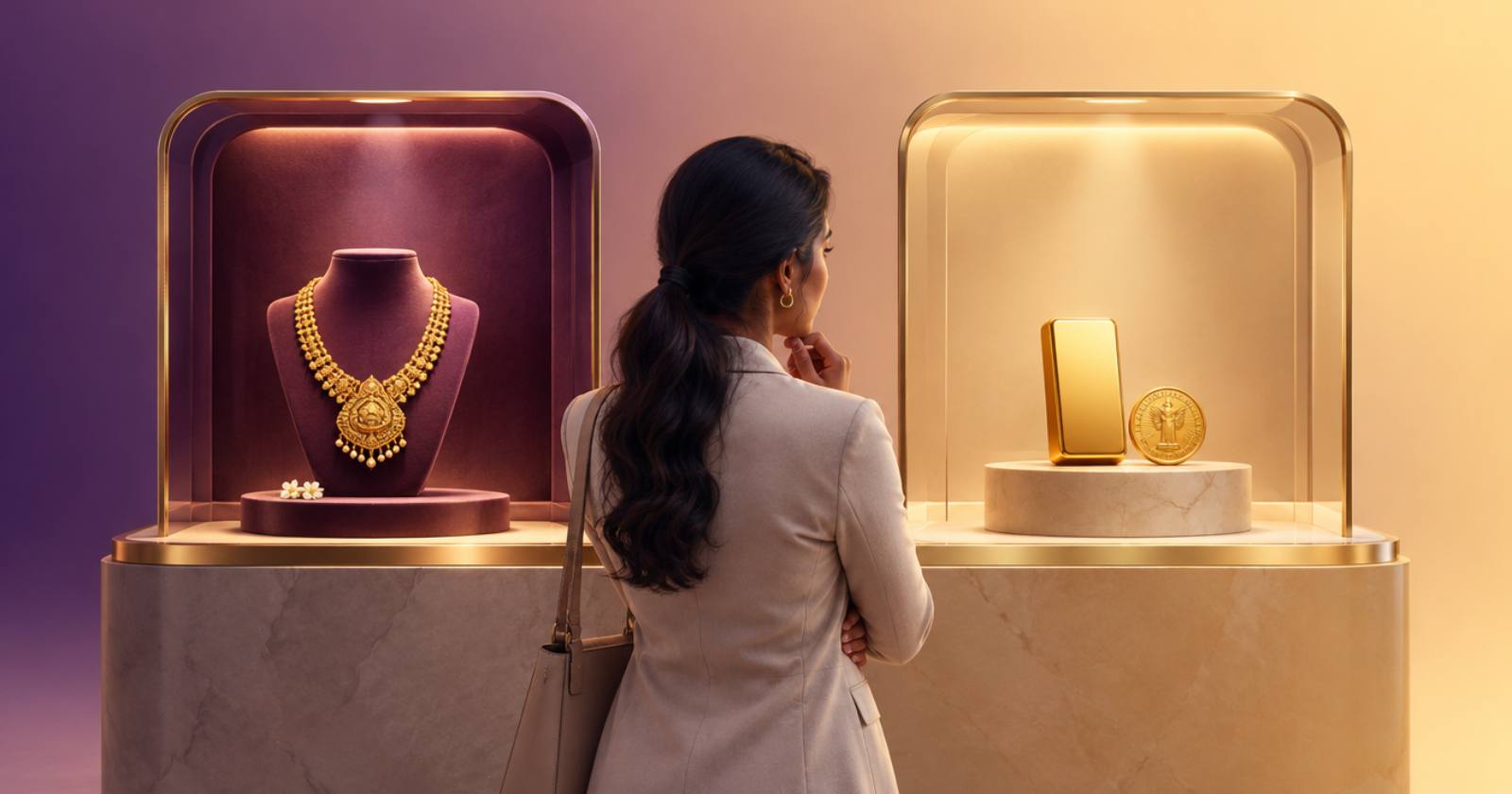
If you walked into a jewellery showroom five years ago, chances are you left with a necklace or a pair of earrings, not a plan. That's changing fast. More Indians today are asking a different question before they buy gold: will this actually grow, or will it just sit in a locker looking pretty? Rising prices have forced a rethink, and for the first time, the numbers show people putting more money into gold as an asset than into gold as adornment. Here's what's driving that shift.
The Numbers Tell Their Own Story
According to the World Gold Council's Q1 2026 Gold Demand Trends report, investment demand for gold overtook jewellery consumption in India for the first time on record.
Category | Q1 2026 Volume | Year-on-Year Change |
Jewellery demand | 66.1 tonnes | down 19% |
Bar and coin demand | 62.3 tonnes | up 34% |
Gold ETF inflows | 19.9 tonnes | up 437% in value |
Total gold demand | 150.6 tonnes | up 10% |
Jewellery value still rose 47% because prices climbed so much, but volume tells the real story. Households bought less jewellery and put more money into coins, bars and ETFs. Investment demand made up over 54% of total consumption that quarter, against a historical average closer to a quarter, a real shift in how the country thinks about its favourite metal.
What Makes Gold Worth Holding
It helps to step back and ask why gold is valuable at all, beyond tradition. Gold doesn't rust or decay, and its supply grows slowly compared to currencies that central banks can print at will. It has held purchasing power across centuries, and currency collapses in a way few other assets have.
That's the core gold store-of-value logic: its worth isn't tied to any one government or company's fortunes. When the rupee weakens, or markets get shaky, gold tends to hold ground, sometimes climb, which is what happened through 2025 when domestic prices nearly doubled while the Nifty 50 managed a modest 2.4% return over the same period.
You May Also Like: Virtual Gold Investment: A Smarter Way to Own Gold
The Trouble With Treating Jewellery as Your Investment
Here's where a lot of households get it wrong. They think of gold jewellery as an investment, and in a limited sense it is, since the metal itself appreciates. But making charges, wastage and design premiums can eat up 10 to 25% of what you pay- value you don't get back on resale.
A bangle bought for its craftsmanship isn't quite the same financial instrument as a gold bar. If the goal is genuinely growing wealth, gold without making charges, in the form of coins, bars or digital gold, does a cleaner job of it.
So What Does Investing in Gold Look Like Now?
If you're wondering how to invest in gold beyond buying jewellery, the options have multiplied. Digital gold investment lets you buy fractional amounts of 24-karat gold online, starting from as little as ten rupees, without worrying about storage or purity checks.
Gold ETFs and sovereign gold bonds work well for people comfortable with demat accounts. A growing number of platforms also let you earn interest on gold you already own instead of leaving it unused, which is why investing in gold turns into a question of what to do with the gold already sitting at home.
You May Also Like: How Much Gold Can You Legally Own in India?
Putting Idle Family Gold to Work
Most Indian households already own gold, often inherited, often sitting in a locker for years. The advantages of gold investment aren't limited to buying more; one of the underrated benefits of investing in gold is learning to put what you already own to use.
This is where platforms like myGold come in. Their physical gold leasing option lets owners lease out the existing gold and earn up to 5% additional gold weight annually, while keeping ownership intact, documented on stamp paper and enforceable by law, with every gram leased fully insured.
For those still building their holdings, myGold's Gold SIP lets you save daily, weekly or monthly through UPI AutoPay, starting from Rs 10, backed by 24kt MMTC PAMP physical gold. It too gets leased out and earns up to 5% additional gold weight annually, so savings don't just sit idle; they work.
That's how gold leasing works in practice: gold gets leased to businesses that need it, and the owner earns a return in gold weight, not rupees, so exposure to the metal never changes.
The Bottom Line
The shift away from jewellery isn't Indians losing interest in gold; gold matters more now, just differently. Families are separating the emotional purchase from the financial one, wearing gold for weddings while parking real savings in forms that actually grow.
FAQs
Does Gen Z prefer gold or silver?
Gen Z leans toward gold for long-term saving, while silver draws younger buyers wanting affordable, trendy jewellery pieces.
Why are young Indians buying gold differently?
Young Indians favour digital gold, SIPs and ETFs over heavy jewellery, prioritising liquidity, lower costs and flexibility over ownership.
Are Indians moving from jewellery to gold investments?
Yes, WGC data shows investment demand overtook jewellery consumption in Q1 2026, marking a genuine shift toward gold as an asset.
Is gold a good hedge against inflation?
Historically, gold has preserved purchasing power during inflation, since its value often rises when currencies weaken or costs climb.